

Ducting.
Impact/Touchdown Protection [Ducting]
Umbilical and cable ducting systems are engineered to provide reliable mechanical protection and long-term performance in demanding environments. Designed with cost optimisation in mind, these systems use abrasion- and impact-resistant materials that have been qualified through rigorous design and testing processes.
OUR TRACK-RECORD
We consistently deliver a simple, practical construction that allows for efficient installation, reducing downtime and labour requirements. With flexible banding material options to suit different budget and performance needs, our ducting can be assembled with economical deployment. Interlocking sections ensure complete coverage and continuous protection, safeguarding umbilicals and cables against external damage while maintaining system integrity.
EXPERIENCE
We consider Ducting/Touchdown Protection a core product given our teams' extensive experience in producing and delivering the scope. Our team have delivered several hundred kilometers over the years.
Track Record in Numbers
65
°A Shore hardness
supplied
20
kJ maximum
impact resistance
3
cable bundle
housed

CASE STUDY
3x Power Cable Bundle Duct
Scope: 45mm OD Power Cable Bundle [3-off] Ducting
Ducting ID: 106mm
Ducting OD: ID + 20mm wall thickness
Banding: Nylon 12
Impact energy: 10000 Joules
Mass of dropped object at v= 0.5m/s: mass≔ 2 ⋅Πe/ν2 = 80000kg
With the duct ID at 106 mm and wall thickness 20 mm, a 10 kJ drop with an impact velocity
of 0.5 m/s gives an estimated dynamic strain of 48%, which is 53% of the allowable 90%
— i.e. the ducting remains within the allowable compressive strain.

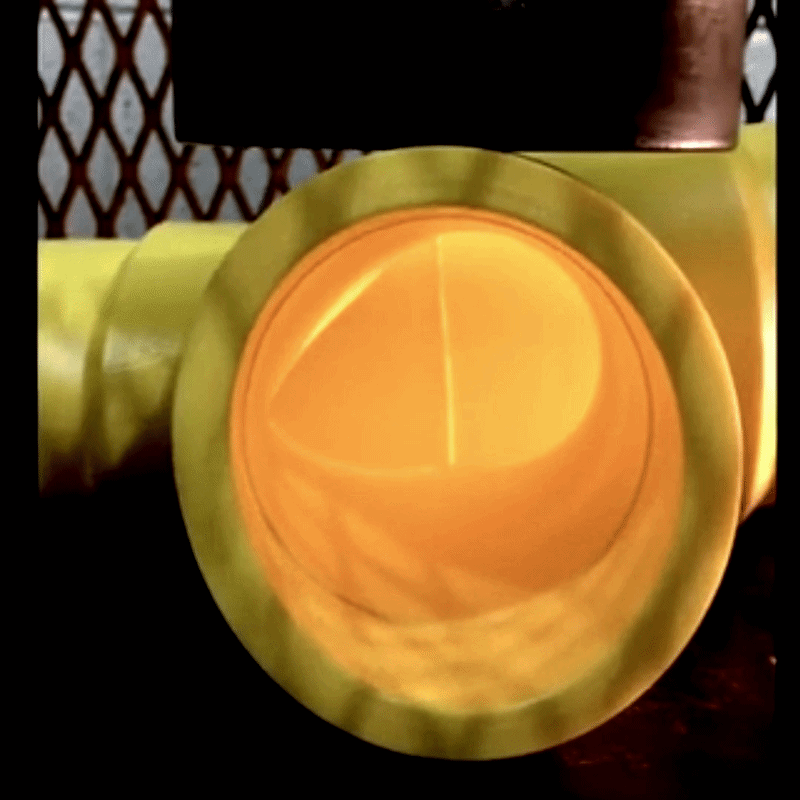
The polyurethane (PU) material is considered to absorb the entire impact energy through a combination of elastic deformation and internal heat dissipation governed by its resilience characteristics.
Considering the specified PU resilience, the proportion of impact energy contributing to compression of the ducting is evaluated. Using the defined wall thickness of the cable duct, the corresponding impact area is established, enabling the calculation of both static and dynamic deflections. From these results, the induced strain is determined and
assessed against the allowable design limit.